



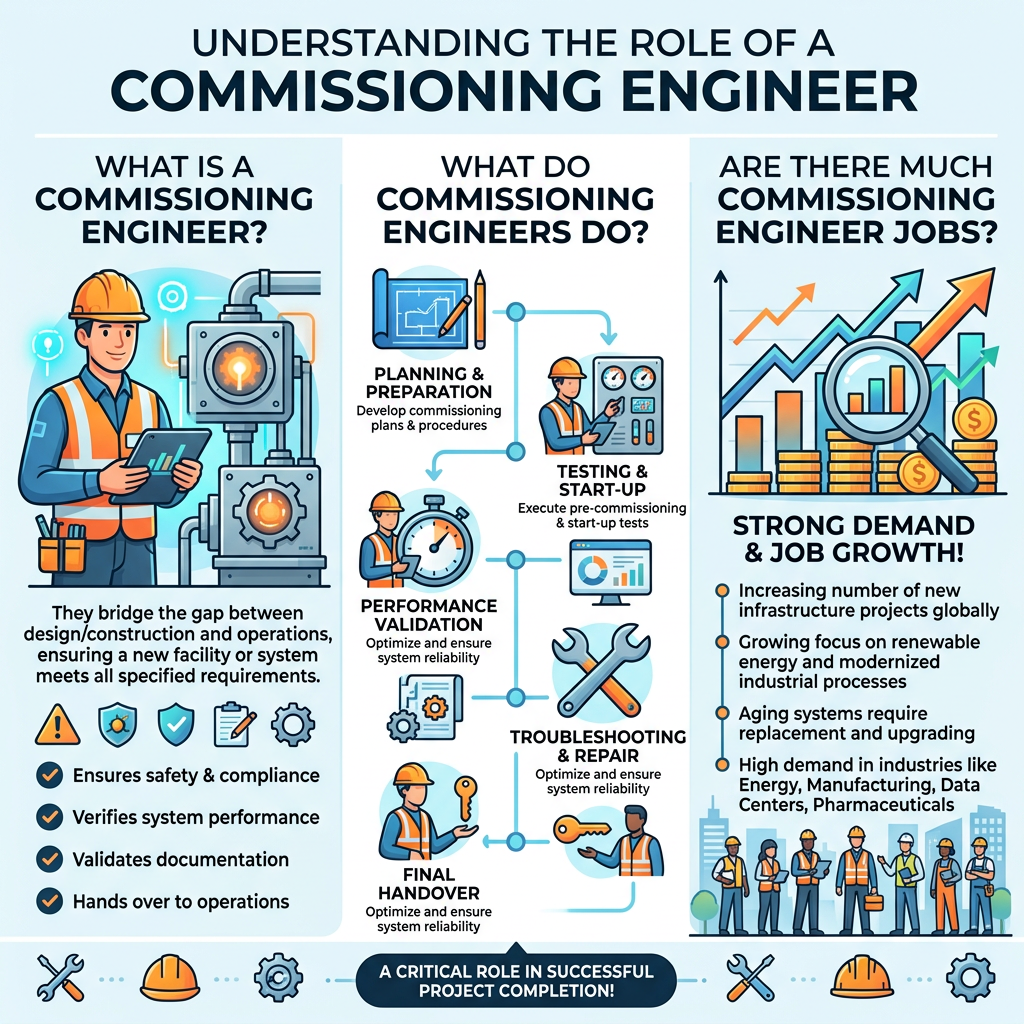
What Is a Commissioning Engineer? What They Do and are there much Commissioning Engineer jobs?
Before a data centre goes live, a pharma plant starts making product or a hospital opens its doors, someone has to prove it all works. That’s the commissioning engineer.
Design and installation get most of the attention on a project, but commissioning is where you find out whether the thing actually does what it was built to do. And with data centres, renewables and pharma all growing across Ireland, the UK and Europe, it’s a skill that’s in demand.
What the commissioning engineer job actually is
A commissioning engineer tests and verifies systems before they’re handed over to the client. It usually happens late in a project, once the equipment has been installed and everyone assumes the hard part is over. It rarely is. Individual components can pass on their own and still fail when they have to work together.
The systems involved depend on the industry, but typically include electrical distribution, generators, UPS systems, HVAC, fire detection, BMS, controls and process equipment. The question behind all of it is simple: does this work properly, safely and as designed?
What you’ll do day to day
Read before you test. You can’t check a system against its design if you don’t know the design. That means drawings, specs, control philosophies, method statements and commissioning plans, often weeks before anything is switched on.
Inspect the installation. Is it built correctly, are the connections finished, is the paperwork and safety sign-off in place? Better to find out before you energise something than after.
Test, and then test harder. Testing is the biggest part of the job, and it goes well beyond “does it turn on?” On a data centre, for example, you’re checking what happens when the mains fails, when a generator doesn’t start or when a UPS goes into bypass. The point is to see how the system behaves when things go wrong, because in a live facility they eventually will.
Find faults. Something will fail. A control sequence won’t behave, or two systems won’t talk to each other. The job is working out what should be happening, what is happening, and why the two don’t match, usually alongside electricians, controls engineers, contractors and manufacturers. Guessing doesn’t work here. You need to be methodical.
Prove performance. A cooling system has to hold temperature under a set load. A generator has to pick up when the supply drops. You record the results and show that the requirements were met.
Run integrated tests. This is where large projects get interesting. The power fails, the UPS takes over, the generators start, the transfer switches operate, the building systems respond and critical equipment stays up. Each system may have passed alone, but the integrated test is where the surprises show up.
Write it all down. Test results, defect lists, certificates, handover packs. It’s not the glamorous part, but the paperwork is what the client actually keeps, and in regulated industries it’s often the whole point.
Where commissioning engineers work
Data centres are the big one in Ireland right now. The systems have to run continuously, so testing is extensive and the tolerance for failure is close to zero. Engineers on large projects often travel abroad for it.
Pharma and life sciences are a major sector here too. You’ll work on cleanrooms, HVAC, utilities, water systems and process equipment, and the documentation standards are strict.
Manufacturing suits people who like a mix of electrical, mechanical and automation work, bringing new production lines and machinery into service.
Energy and utilities cover power stations, solar and wind farms, battery storage and substations. Grid and renewables growth is creating demand for people with electrical and controls skills.
Commercial and building services means hospitals, hotels and large buildings, where you’re testing HVAC, electrical, fire systems and the BMS.
Commissioning vs project engineering
The roles overlap and often work closely together. Roughly, the project engineer asks whether the system has been designed and installed correctly, and the commissioning engineer asks whether it operates correctly under every condition it’s required to handle.
Skills that matter
You need a solid technical base in electrical or mechanical engineering, controls, drawings and safety, but nobody knows everything at the start, and most people specialise as they go.
What separates good commissioning engineers is less obvious. They stay calm when a test fails. They troubleshoot logically instead of swapping parts and hoping. They keep accurate records, because a project can involve thousands of individual tests and you need to know what’s passed, what hasn’t and what’s outstanding. And they can explain a technical problem clearly to a site manager, a contractor or a client without making anyone defensive, which matters more than people expect.
[Suggested addition: one short real example of a fault that took a while to find. It would do more for this section than any list.]
How to become a Commissioning Engineer!
There’s no single route.
Degree. Electrical, mechanical, electronic, automation, building services or control engineering are the usual ones. Graduates typically start as graduate, site or project engineers and move into commissioning from there.
Apprenticeship. An electrical or mechanical apprenticeship gives you hands-on experience that’s hard to replicate in a classroom, and it’s a perfectly good path into commissioning.
Electrician or technician. Plenty of commissioning engineers started as electricians or as electrical, mechanical, controls or instrumentation technicians. People who’ve worked with the equipment tend to spot problems faster, because they know how it behaves in real life.
On qualifications, employers usually look for a degree or apprenticeship, electrical testing qualifications, Safe Pass, manual handling and relevant health and safety training. Some also want manufacturer or industry-specific certification. In Ireland, chartership through Engineers Ireland is worth considering as you progress. But experience counts for a lot in this field, sometimes more than the piece of paper.
What a day looks like
There isn’t really a typical one, but a busy site day might run something like this:
- 07:00 Site briefing and safety meeting
- 08:00 Review the day’s commissioning activities
- 09:00 Equipment testing
- 11:00 Chase down a failed test
- 13:00 Paperwork and reporting
- 14:00 Integrated systems testing
- 16:00 Review results and plan tomorrow
Things speed up noticeably as handover approaches.
Travel
Often, yes. Commissioning is project-based, so you go where the project is. In Ireland that might mean Dublin, Cork or elsewhere. For larger contractors it can mean the UK, Europe, the Middle East, North America or Asia. It varies a lot by employer, though. Some roles are based on one site for a year or more, others are almost constantly on the move.
Pay
What I can say without figures is that pay depends heavily on experience, sector and how much travel is involved. Data centres, pharma, power generation and controls tend to pay best. On international work, look at the whole package rather than just the salary: accommodation, travel, allowances and rotation patterns can change the value of an offer a lot.
| Level | Rough base salary |
|---|---|
| Graduate / junior | €40k-€50k |
| Mid-level | €50k-€70k |
| Senior / data centre specialist | €75k-€105k+ |
Is it a good career?
If you like solving problems, working with real equipment and seeing the results of your work switch on, yes. It’s a poor fit if you want to be at a desk all day.
Progression tends to lead to senior or lead commissioning engineer, commissioning manager, project engineer or manager, and technical or engineering manager. Some people move into consultancy or client-side roles.
Where it’s heading
Systems are getting more connected and more automated, so the boundaries between electrical, mechanical, controls and software are blurring. The commissioning engineers who do best will be the ones who understand how whole systems interact, not just individual pieces of kit.
Thinking about making the move?
If you’re already an electrician, technician or site engineer, you likely have more of the foundation than you think. Pick the area that interests you most, whether that’s data centres, pharma, energy or something else, and start building experience there. It also helps to talk to people already doing the job and read real vacancies closely. They’ll tell you what employers want better than any article can.
Check out our lives jobs for Commissioning, Electrical and Mechanical Engineer jobs here. You can also visit our dedicated Data Center careers page here and catch up on the latest news here .