




The Complete Network Engineer Career Guide: Ireland, UK, EU & USA (2026)
If you are Network Engineer looking for a job in Dublin, London, New York or Sydney this guide will be relevant for you. In the blog, we cover areas such as, Network Engineer jobs in Dublin, Salaries. Career paths. Every specialism within network Engineering compared. One place.
Whether you’re a network engineer benchmarking your salary, looking for a job, or just starting out, this is your one-stop guide to network engineering careers in Ireland and beyond.
Types of Network Engineers {#types}
“Network engineer” covers a lot of ground. Here’s a breakdown of the main specialisms, what platforms you’ll work on, and what each path pays.
| ☁️ Cloud Networking Platforms: AWS, Azure, GCP Design and operate virtual networks inside hyperscaler environments. Covers VPCs, transit gateways, direct connect, peering, and software-defined overlays. The fastest-growing and best-paid discipline in 2025. Best for: Automation-minded engineers, developers moving into infrastructure Pay premium (Ireland): 25–40% above market average | 💡 Optical / DWDM / Submarine Platforms: Ciena, Nokia, Infinera, Huawei Wavelength-division multiplexing across long-haul fibre. Powers the backbone of the internet, international cable systems, and data-centre interconnect (DCI). Niche, technically deep, and very well compensated. Best for: Engineers who enjoy physics-level problem solving and complex lab work Pay premium (Ireland): 20–35% above market average | 🌐 IP / BGP / MPLS Platforms: Cisco IOS-XR, Nokia SR-OS, Juniper Junos Layer 3 routing at scale. BGP is the protocol of the internet; MPLS provides traffic engineering across service provider networks. A cornerstone skill that underpins most high-paying network roles. Best for: Engineers who love protocols, traffic engineering, and deep troubleshooting Pay premium (Ireland): 15–25% above market average |
See all Network Engineer jobs here
| 📡 Telecoms / 5G / LTE Platforms: Ericsson, Nokia, Huawei, Open RAN Mobile core, RAN, and fixed-line networks. 5G and Open RAN are transforming the sector with virtualised network functions (VNFs/CNFs) and cloud-native architectures. High demand across Ireland and Europe. Best for: Engineers who want to work on cutting-edge public infrastructure Pay premium (Ireland): 15–30% above market average | 🛡️ Network Security Platforms: Palo Alto, Fortinet, Cisco, Zscaler Firewalls, zero-trust architecture (ZTA), SASE, IDS/IPS, and microsegmentation. Demand has far outpaced supply in Ireland for three consecutive years. Combination of networking + security knowledge commands serious salary premiums. Best for: Detail-oriented engineers with a security mindset Pay premium (Ireland): 20–35% above market average | 🏭 Data Centre Networking Platforms: Cisco ACI, Arista EOS, Juniper QFX Leaf-spine fabric design, EVPN/VXLAN overlays, and high-density interconnect. Ireland’s position as a European hyperscale hub (AWS, Meta, Microsoft, Google) makes this one of the most in-demand disciplines in the country. Best for: Engineers who want to work at the heart of the cloud Pay premium (Ireland): 20–30% above market average |
Network Engineer Career Progression Ladder {#career}
From NOC analyst to Director of Engineering — here is the full network engineering career ladder with honest timelines, salary ranges, and the certifications that matter at each stage.
Stage 1 — NOC / Helpdesk Analyst
- Experience: 0–2 years | Ireland Salary: €28,000 – €40,000
- Focus at this level: Monitoring, ticketing, basic troubleshooting, escalations Key certifications: CompTIA Network+, CCNA (pursuing)
Stage 2 — Junior / Graduate Network Engineer
- Experience: 1–3 years | Ireland Salary: €35,000 – €48,000
- Focus at this level: Device config, LAN/WAN support, incident resolution, vendor portals
- Key certifications: CCNA, CompTIA Network+
Stage 3 — Mid-Level Network Engineer
- Experience: 3–6 years | Ireland Salary: €50,000 – €70,000
- Focus at this level: BGP/OSPF/MPLS, firewall policy, project delivery, mentoring juniors
- Key certifications: CCNP, NSE4, JNCIS
Stage 4 — Senior Network Engineer
- Experience: 5–10 years | Ireland Salary: €70,000 – €95,000
- Focus at this level: Architecture decisions, BAU leadership, vendor evaluation, automation (Python/Ansible)
- Key certifications: CCNP (advanced), CCIE (pursuing), NSE7, JNCIP
Stage 5 — Lead / Principal Network Engineer
- Experience: 8–13 years | Ireland Salary: €90,000 – €120,000
- Focus at this level: Technical authority, cross-team design, hiring decisions, standards ownership
- Key certifications: CCIE, CCDE, NSE8 – See all Cisco Certifications here
Stage 6 — Network Architect
- Experience: 10–15 years | Ireland Salary: €110,000 – €145,000
- Focus at this level: End-to-end network design, business alignment, technology roadmap
- Key certifications: CCIE / CCDE, cloud architect certs (AWS / Azure)
Stage 7 — Head of Network Engineering / Director
- Experience: 15+ years | Ireland Salary: €130,000 – €180,000+
- Focus at this level: Team leadership, P&L ownership, strategic vendor relationships, board-level reporting
- Key certifications: Business/leadership qualifications; deep domain authority
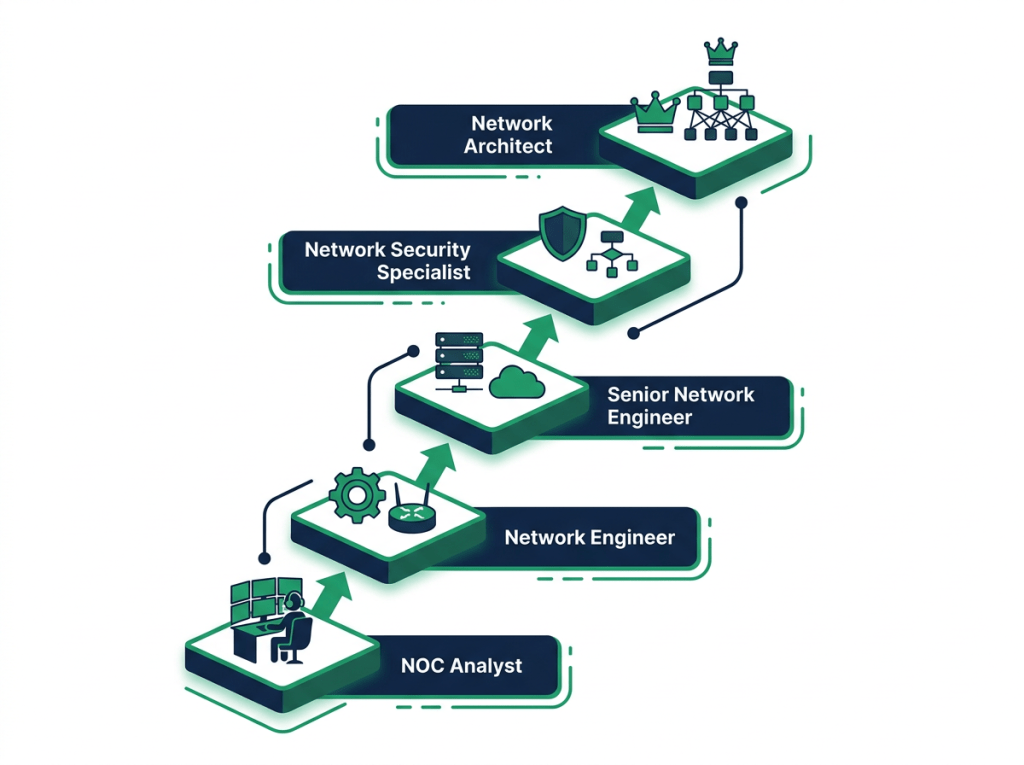
Honest timeline note: Timelines above assume consistent progression in Ireland’s market. There are many ways this is disrupted depending on succession planning. Career moves can accelerate significantly by changing employer (typically 15–30% pay uplift per move) rather than relying on internal promotion. The engineers who progress fastest combine technical depth with communication skills and the ability to articulate business impact not just technical capability. The rule of thumb is, if you have not moved up in 18-24 months, its time to have that difficult discussion with your Manager / Director.
Network Engineer Contractor & Day Rates in Ireland (2026)
For those Network Engineers who contract, the above still applies, but itws important to work in an enviroment that promotes contractors. Lots of contractors move up as they move contract, but we all know stability is important where possible. Below is our expeirence on rates. We are aware these differ depending on the role, sector etc.
| Network Engineer Job / Position | Day Rate |
| Junior Network Engineer (contract) | €250 – €350/day |
| Mid-Level Network Engineer | €350 – €400/day |
| Senior Network Engineer | €400 – €650/day |
| Network Security (CCIE / PCCSE) | €350 – €700/day |
| Cloud Network Engineer (AWS / Azure) | €550 – €750/day |
| Optical / DWDM Specialist | €400 – €600/day |
| Network Architect | €500 – €700/day |
| Freelance NOC Analyst | €200 – €300/day |
🇮🇪 Ireland Context
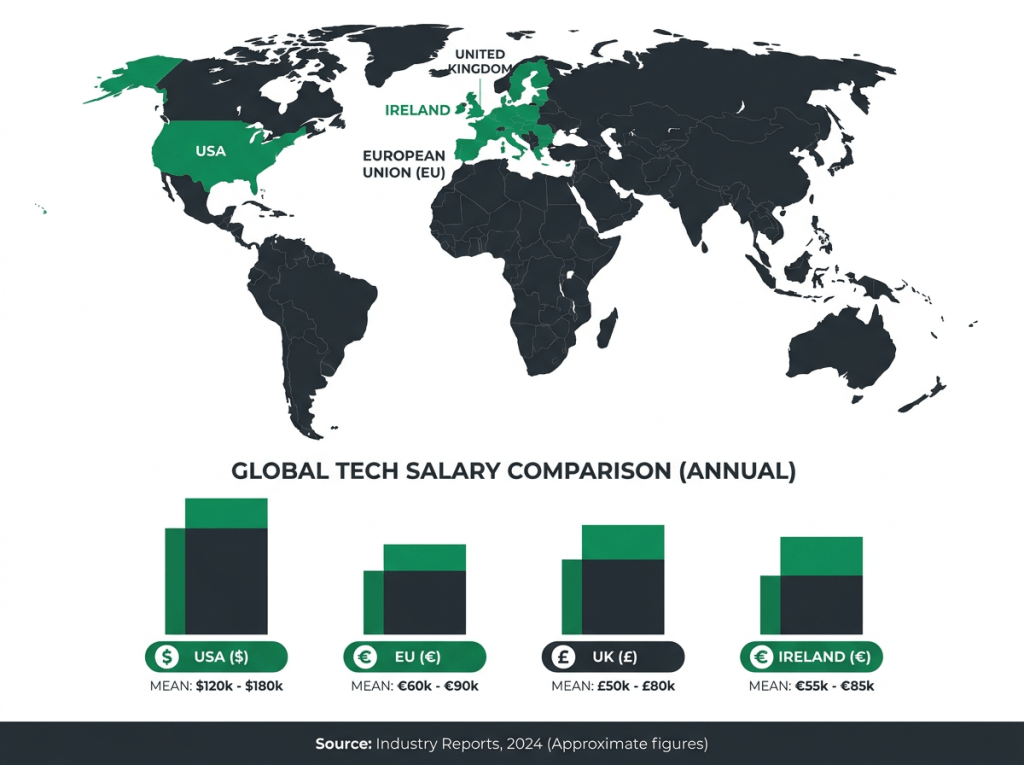
Dublin leads. Cork and Galway offer 10–20% less but are growing fast. Ireland’s tech density means genuine demand, not just job titles. Contract day rates run €350–€800/day depending on specialism. CCIE holders command top-of-range.
🇬🇧🇪🇺 UK & EU Context
UK figures are for London. Germany (Munich, Berlin) pays comparably to Dublin in absolute terms but note higher income tax. Netherlands, Switzerland, and Finland also pay well. UK contractor market is strong but IR35 complexity adds friction.
🇺🇸 USA Context
US figures are for major tech hubs (San Francisco, New York, Seattle). Total comp including RSU equity can be 40–80% above base. Cost of living offsets much of the differential — but for CCIE-level engineers, the USA gap is real and significant.
Where should you specialise to maximise pay?
🥇 Highest ceiling: Cloud Networking + Network Security. Both benefit from persistent demand and low candidate supply. A combination of both is the strongest position in the Irish market.
🥈 Best niche premium: Optical / DWDM and IP Routing at ISP/carrier level. Small talent pool, technically demanding — employers pay to retain these skills.
🥉 Best long-term bet: Network Automation (Python + Ansible). It’s becoming a prerequisite rather than a bonus. Engineers who can automate will pull ahead over the next 5 years.
Notes by Specialisation in Network Engineering
- Cloud Networking: Hyperscaler roles command top-of-market pay. SD-WAN, VPC design, and Transit Gateway expertise are key differentiators.
- Optical / DWDM: Subsea cable, backbone, and data-centre interconnect projects are driving demand. Ciena, Nokia, and Infinera platforms dominate.
- IP / BGP / MPLS: Core skill for ISPs, carriers, and large enterprises. Cisco IOS-XR, Nokia SR-OS, and Juniper Junos are the main platforms.
- Telecoms / 5G: 5G rollout and Open RAN are creating significant demand. Vendors include Ericsson, Nokia, and Huawei.
- Network Security: Palo Alto, Fortinet, and Cisco Firepower expertise is in very short supply across Ireland and the EU.
- Data Centre Networking: Ireland’s hyperscale DC build-out (AWS, Meta, Microsoft, Google) means consistent demand for leaf-spine and fabric engineers.
- SD-WAN / Automation: Python, Ansible, Terraform, and REST API skills are now expected alongside traditional networking credentials.
- NOC Engineering: Excellent entry point. Shift-based work at ISPs, managed service providers, and data centres. Strong springboard to engineering roles.
How to get into Network Engineering or Progress your career as a Network Engineer.
Starting at Zero – Here is how to start your career as a Network Engineer.
- Study CompTIA Network+ — it’s vendor-neutral and proves fundamentals
- Build a home lab: GNS3, EVE-NG, or Packet Tracer for Cisco basics
- Begin CCNA studies — it’s the entry ticket for most Irish employers
- Target Helpdesk or NOC roles — they build real troubleshooting muscle
- Stick out the first 12–18 months. The learning curve is steep but worth it
If you are currently working in IT Infrastructure, or a related disipline, herea re some steps to fast track your career into Network Engineering
- Map your transferable skills: sysadmins already understand routing and DNS basics
- CCNA is still the fastest credibility signal for hiring managers
- Use your existing employer if possible — internal moves are underrated
- Target MSPs (managed service providers) for broad exposure across industries
- Emphasise troubleshooting and problem-solving experience in applications
Advancing your career as a Network Engineer, here are 5 steps to help get you there:
- Pursue CCNP (or Juniper/Fortinet equivalent for your market)
- Take ownership of a project end-to-end — employers promote problem owners
- Start learning Python and Ansible. Even basic scripting sets you apart
- If internal promotion stalls, change employer — 20%+ uplift is common
- Mentor juniors: it signals readiness for lead roles faster than certs alone
Once you have Mastered Network Engineering, the next technical step would be Architecture. Here are the best ways to become a Network Architect.
- CCIE or CCDE is near-mandatory as a technical signal at this level
- Add cloud architecture credentials (AWS Solutions Architect, AZ-305)
- Develop a pattern of cross-team design work — not just technical delivery
- Get comfortable presenting to non-technical stakeholders
- Think in terms of business outcomes, not just packet flows
Elwood Roberts works closely with some of the leading Cloud and Telecoms businesses in the market with a dedicated team to support both job seekers and businesses to find the right match for both. Our job as a Recruiter is to act as an Agent to support the job seekers career asperations and find the businesses we work with the best staff for their business. If you are either looking for a Network Engineer or indeed looking for a job, please get in touch now, here!
For more career tips, see our career hub on our Website here