



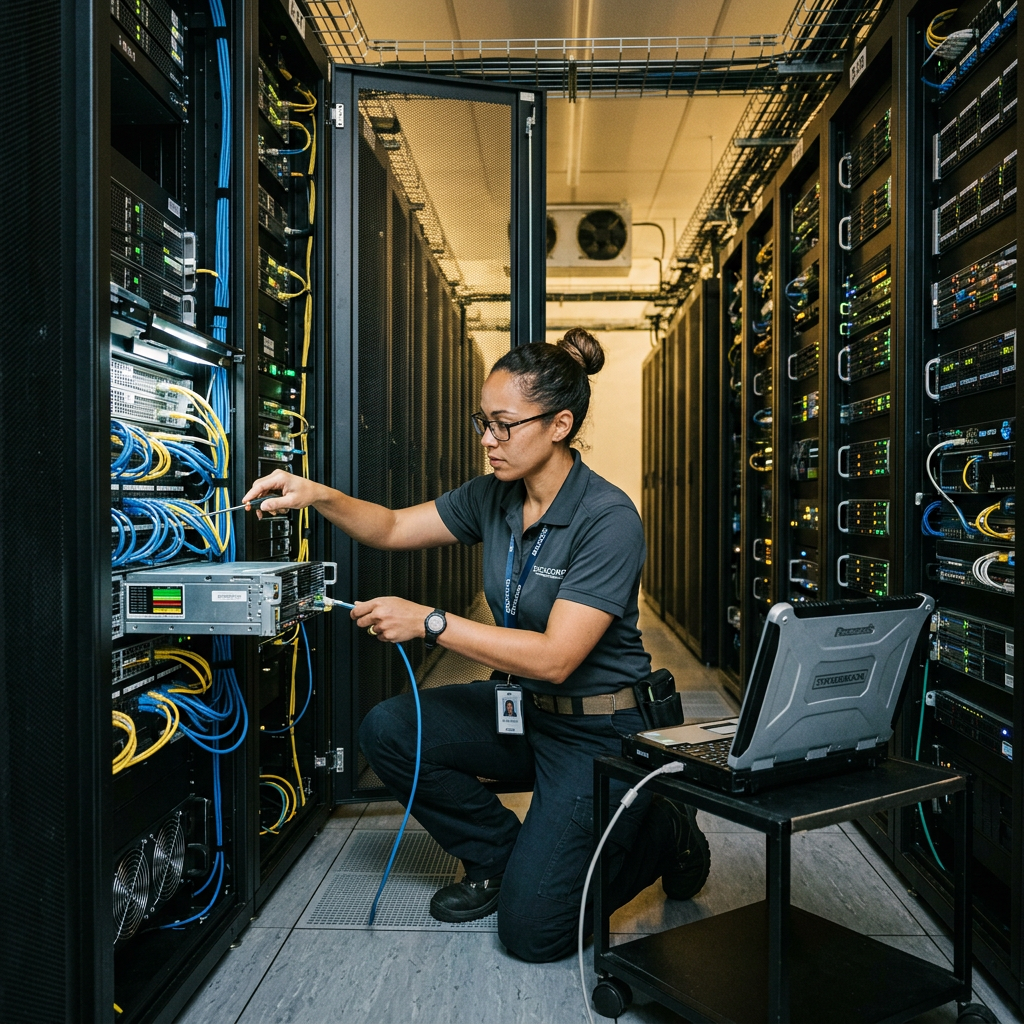
When society talks about the future of Artificial Intelligence, the conversation almost always revolves around code, neural networks, and multi-billion-dollar large language models. But behind every single response generated by an AI lies a massive, humming physical complex packed with high-voltage electricity, pressurized cooling fluids, and miles of optical fiber. Data Center Engineers job in Dublin is becoming more and more popular.
What we have found after 18 years in the sector, is most people fall into it, mid career. With the huge investments going into Data Centers in order to power the AI revolution, Data Center jobs in Dublin are becoming more interesting to graduates and more junior Engineers eager to progress their career in the sector.
These installations do not run themselves. While Silicon Valley builds the software, Data Center Engineers build, protect, and maintain the physical layer of the internet.
If you have ever wondered what it actually takes to keep the digital world from overheating and how you can break into this high-paying, future-proof career, here is the unvarnished reality of life on the data center floor.
A Day in the Life: Inside the Megawatt Sandbox that is a Data Center
A Data Center Engineer does not sit at a traditional desk typing out code. Their workspace is an expansive, high-density industrial environment where a single mistake can plunge millions of users into darkness.
A typical 12-hour shift balances strict operational compliance with fast-paced troubleshooting:
- 07:00 – The Shift Handover: The day begins by reviewing logs from the night shift. In a 24/7/365 environment, continuity is everything. Engineers scan for any telemetry anomalies in the Building Management System (BMS) or Electrical Power Monitoring System (EPMS).
- 09:00 – The Critical Walkthrough: Armed with thermal imaging cameras, engineers walk the hot aisles. With modern AI clusters pushing server racks past 100 kW of power density, keeping a physical eye out for micro-leaks in direct-to-chip liquid cooling systems or hot spots in electrical distribution panels is a daily necessity.
- 11:30 – Preventive Maintenance & Isolation: A critical substation transformer requires servicing. The engineer leads the execution of a complex Method of Procedure (MOP) to safely divert megawatts of electricity to redundant backup lines without dropping a single microsecond of server power.
- 14:00 – Incident Response: A predictive maintenance alert flags an air-locked cooling line in a liquid immersion bay. The engineer steps in physically, utilizing specialized equipment to bleed the line, balance fluid pressures, and keep a million-dollar GPU cluster from hitting its thermal limit.
- 16:30 – Capacity Planning & Vendor Management: Meeting with infrastructure architects to oversee the delivery of next-generation hardware. The engineer ensures that physical floor weight limits, power availability, and localized structural configurations align perfectly with upcoming hardware requirements.
The Career Path: From Operative to Elite Engineer
You do not need an elite computer science degree to build a career in digital infrastructure. The data center sector is one of the few remaining industries where a motivated professional can climb from an entry-level position to a lucrative engineering role through hands-on experience and targeted technical certifications.
The typical roadmap to becoming a Data Center Engineer evolves across distinct milestones:
| Data Center Operative | Data Center Technican | Data Center Engineer | Chief Engineer |
Step 1: Data Center Operative / Logistics Specialist
- The Focus: Managing the physical perimeter. This entry-level role handles shipping, receiving, unboxing multi-million dollar server inventory, physical security protocols, and escorting third-party contractors on-site. It provides an excellent baseline understanding of facility layout and strict operational security.
Step 2: Hardware / Data Center Technician
- The Focus: Mastering the server racks. Technicians are the hands-on specialists responsible for racking and stacking server blades, running structural fiber-optic cables, replacing hot-swappable components (like faulty drives or RAM), and basic network troubleshooting.
Step 3: Data Center Engineer / Critical Facilities Engineer (CFE)
- The Focus: Managing the macro environment. At this level, the focus shifts entirely from individual server blades to the heavy industrial infrastructure powering them. CFEs are masters of mechanical engineering (chilled water loops, direct-to-chip liquid cooling, complex HVAC) and electrical engineering (uninterruptible power supplies, high-voltage switchgear, massive backup diesel generators).
Why AI Can Never Take This Job
The tech industry is currently gripped by fear that AI software will automate millions of jobs out of existence. But for Data Center Engineers, their job security has never been higher.
The fundamental reason is simple: AI software cannot step into physical space.
An AI model can look at sensor telemetry and predict when a cooling valve might fail or where an electrical arc flash is likely to occur. It can send the warning, but it cannot pick up a wrench. It cannot physically purge an air-locked liquid loop, manually reset a tripped high-voltage circuit breaker, or safely service an industrial diesel generator during a regional grid failure.
Furthermore, as AI hardware advances, data center architectures are becoming incredibly complex. We are rapidly moving past traditional air cooling into highly complex fluid dynamics like dielectric immersion cooling. The physical variables, irregular environments, and immense risk associated with high-voltage and high-pressure infrastructure mean that adaptive, expert human judgment remains entirely irreplaceable.
Financial Rewards: What Can You Expect to Earn?
Because the global data center sector is facing an acute talent bottleneck, salaries have climbed significantly across major digital hubs to attract and retain skilled personnel.
The compensation scale directly reflects the specialized nature of managing critical infrastructure:
- Entry-Level (Operatives / Junior Techs): Starting salaries typically range from €40,000 to €55,000 ($45,000 to $60,000 USD) depending on the region.
- Mid-Level (Data Center Engineers / CFEs): Experienced engineers managing live critical infrastructure command median base salaries between €55,000 and €80,000 (stretching past $110,000+ in high-demand US markets).
- Senior / Chief Facilities Engineers: Elite leads tasked with overseeing entire multi-megawatt campus environments frequently earn between €85,000 and €110,000+ ($160,000+ USD in the United States), often complemented by substantial corporate bonuses, health benefits, and equity packages.
The data center engineer is the ultimate line of defense for the modern digital economy. They are the professionals who transform abstract cloud data and complex algorithms into real-world, operational reality. If you are looking for a career path that balances cutting-edge technology, heavy industrial engineering, excellent financial compensation, and complete immunity to AI automation, the data center floor is exactly where you belong. If you are interested in a Data Center Engineer jobs in dublin, check our careers page here. For career tips in general – click here