



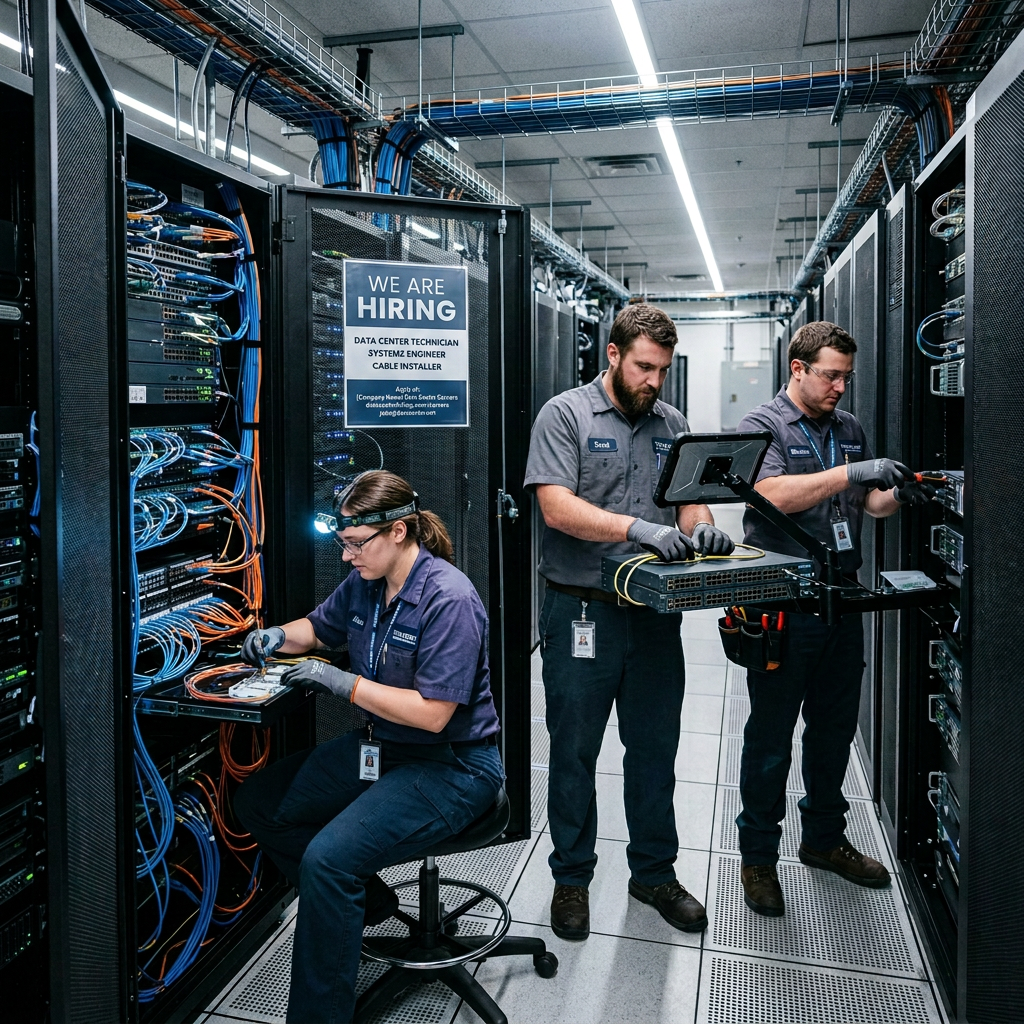
The Irish and European data center sector is in the middle of one of the most aggressive buildout cycles in its history. Hyperscale campuses are expanding across Dublin’s North Fringe. New colocation sites are breaking ground in Frankfurt, Amsterdam, and Warsaw. AI-ready infrastructure is being fast-tracked across the continent. The projects are funded. The planning permissions are progressing. The hardware is on order.
The problem is the people.
We’re seeing it directly with our clients, and we’re hearing it from every operator. From M&E contractor, and project developer we speak to. The skilled trades workforce needed to build and run these facilities, simply isn’t keeping pace with the volume of work on the table. This post sets out what’s driving the gap. What it’s costing the sector, and what serious operators are doing about it.

The Extent of the Data Center Skills Shortage
The data center sector has two distinct but related workforce challenges: building new facilities and keeping existing ones running.
On the new build side:. The roles most critically short are data center-qualified electricians, mechanical engineers with HVAC and cooling expertise and Building Management Systems (BMS) engineers and PM’s with Data Center experience. These are not roles you can fill with general tradespeople. The specifications, safety requirements, and systems complexity demand sector-specific experience that takes years to develop. Now, training has been very effective and we are seeing more and more trades join from other sectors.
On the FM (facilities management) side, the problem is retention and replacement. Experienced data center operators are ageing out of the workforce at a rate the industry is struggling to absorb. A BMS engineer who has spent twelve years managing a 50MW campus cannot be replaced by someone who has spent six months in a classroom.
The result: fill rates for critical data center roles in Ireland are running well below average. Clients are telling us that roles which would have filled in three to four weeks two years ago are now taking eight to twelve weeks. That’s with active, specialist recruitment support.
Bringing Early Retirees Back
One of the more pragmatic trends we’re observing is data center operators. Their M&E contractor partners are actively reaching out to recently retired or semi-retired tradespeople. This is not a new concept in engineering sectors, but it has become markedly more structured in the past year.
The typical arrangement involves a short-term contract of three to nine months. Often with flexible hours and a rate premium that reflects the scarcity premium these workers now command. The roles they fill tend to fall into two categories. Hands-on delivery for specific commissioning phases. And mentoring or technical oversight of junior and mid-level teams who need direct knowledge transfer that formal training cannot provide.
For operators, it is a sensible bridge. For the individuals, it offers meaningful work at a pace they can manage. The challenge is supply — there are only so many retired data center electricians and BMS engineers in the market, and word-of-mouth networks move faster than job boards in this cohort. This is where specialist recruitment partners with deep market relationships have a clear advantage.
Where the Skilled Trades Are coming from.
Domestic supply cannot close the gap on its own. The operators and contractors who are managing best are those who have invested in international sourcing — particularly from within the EU, where the legal and logistical pathway is more straightforward.
Romania and Bulgaria have become well-established talent pools for skilled trades in the data center sector. Romania’s technical education system — centred on universities of technology in Bucharest, Cluj-Napoca, and Timișoara — produces strong graduates in electrical and mechanical engineering, and the country has a long tradition of applied industrial training at vocational level. Bulgarian trades workers, particularly in electrical and HVAC, carry recognised EU certifications and have a track record of relocation to Western Europe for better-paid roles. In both countries, wages remain significantly lower than Irish equivalents, making the offer of Irish rates — even at the lower end of the market — genuinely compelling.
Poland remains the largest single source of skilled trades workers relocating to Ireland. Polish electricians and mechanical engineers are well regarded for their technical rigour and work rate. The country has a mature apprenticeship system and a large base of workers with direct industrial and infrastructure experience.
Hungary and the Czech Republic are worth highlighting for BMS and automation-specific skills. Both countries have significant manufacturing and industrial automation sectors, and workers with PLC, SCADA, and BMS backgrounds are more readily available than in Ireland or the UK. Language proficiency in English is improving rapidly in the under-40 cohort.
Slovakia and Latvia offer similar profiles to Poland for electrical trades, with the added advantage that both countries have relatively smaller domestic construction booms at present, meaning workers are more willing to consider international moves.
Lithuania and Portugal round out the picture. Lithuanian trades workers have a strong record in Ireland already, and the community infrastructure in Dublin makes integration easier. Portuguese electrical and civil engineering professionals are increasingly looking north and east as Portugal’s own cost base rises, and their EU credentials transfer directly.
For non-EU hires — for example, recruiting from the Philippines or South Africa for data center operations roles — the Critical Skills Employment Permit (CSEP) is the primary route. It applies to roles on the Department of Enterprise’s eligible occupation list, covers a range of engineering and technical positions, and requires a minimum salary threshold. Employers must also demonstrate that the position has been advertised in Ireland and the EU first. Relocation support, language assessment, and integration planning are not optional extras — they are fundamental to retention. We have seen hires fail within six months not because the candidate lacked the skill, but because the transition support was inadequate.
What It’s Costing: Rising Labour Rates in the Trades in Ireland.
The cost reality is one that clients increasingly need to plan for honestly. Here are approximate annual salary benchmarks for Ireland in 2025/2026, based on current market placements and published surveys:
| Role | Approx. Annual Salary (Ireland, 2025/26) |
| Electrician (data center qualified) | €50,000 – €70,000 |
| Mechanical / HVAC Engineer | €55,000 – €75,000 |
| BMS Engineer | €55,000 – €80,000 |
| Facilities Engineer | €50,000 – €65,000 |
| Facilities Manager | €70,000 – €90,000 |
| Construction Project Manager (data center) | €85,000 – €120,000 |
| Alarm / Security Engineer | €40,000 – €55,000 |
These figures represent a 20–35% uplift on equivalent roles five years ago. Senior BMS and project management positions have seen the steepest increases — in some cases over 40% since 2021 — driven by concentrated demand and very limited supply at the senior end.
Day rates for contract positions reflect the same pressure. A data center-qualified electrician contracting in Dublin is currently commanding €300–€380 per day. An experienced BMS engineer on contract can achieve €400–€500. These rates were significantly lower even eighteen months ago.
For project developers, this is a direct input cost escalation. For operators running existing facilities, it is a budget line that has moved materially without any corresponding increase in headcount or service delivery. The financial impact is real, and it is not going away.
How This Is Affecting the Data Center Sector.
Beyond individual hiring decisions, the skill shortage is having structural effects on the data center industry that deserve to be named plainly.
New build timelines are slipping. Projects that would have been delivered in 28 months are now running to 36 or 38 months in some cases, with electrical and commissioning phases being the most common bottlenecks. This has knock-on effects for hyperscale clients who have committed capacity to enterprise customers.
Operational resilience is being stretched. When an experienced BMS engineer leaves a facility and cannot be replaced for three months, that represents real risk to uptime SLAs. Operators are managing this through overtime, contractor cover, and in some cases reducing maintenance windows — none of which are sustainable long-term.
AI infrastructure is amplifying everything. The power density requirements of AI-ready data centers — liquid cooling, high-density power distribution, new UPS configurations — demand a skills profile that barely existed at scale five years ago. The race to build this infrastructure is running directly into the most constrained labour market the sector has seen in a generation.
Operators are responding in a number of ways: increased investment in apprenticeship programmes and graduate pipelines, partnerships with third-level colleges, expanded use of international recruitment, and greater investment in automation and predictive maintenance to reduce the hands-on labour requirement over time. These are the right responses — but they take time to yield results.
What Practical Solutions Look Like
There is no single answer here, but there are approaches that work. The clients managing best are those combining several of them.
Specialist recruitment support matters more in constrained markets than in buoyant ones. A general recruiter will not have the network or the sector knowledge to find a BMS engineer with hyperscale commissioning experience. The fill rate differential is significant, and so is the quality of match at shortlist stage. At Elwood Roberts, we work exclusively in IT and engineering — this is not a market we dip into; it is the only market we operate in.
RPO (Recruitment Process Outsourcing) is increasingly relevant for operators and contractors who are hiring at volume. For organisations bringing on three or more technical hires per month, an embedded RPO model delivers faster time-to-fill, more consistent candidate quality, and a lower total cost per hire than ad hoc agency use.
College and apprenticeship partnerships are the medium-term play. We are actively involved in supporting the MTU Cyber Innovate programme as an example of how industry and education can work together to develop the skills pipeline the sector needs. More of these relationships, at electrical, mechanical, and BMS level, are needed across Ireland.
International sourcing done properly — with compliance, relocation support, and genuine integration planning — is the fastest lever available to close the gap right now. It requires investment and process, but the talent is there.
The skill shortage in data center trades is not a problem that is going to resolve itself in the next twelve months. The operators and contractors who treat it as a strategic issue — not a reactive HR problem — will be the ones who deliver projects on time and maintain operational resilience as the sector continues to grow.
If you are facing these challenges — whether you are building new facilities, trying to stabilise your FM team, or planning a hiring programme for the next 12–18 months — talk to us. We work with data center operators, M&E contractors, and infrastructure businesses across Ireland and the EU, and we have the market knowledge and the network to help.