



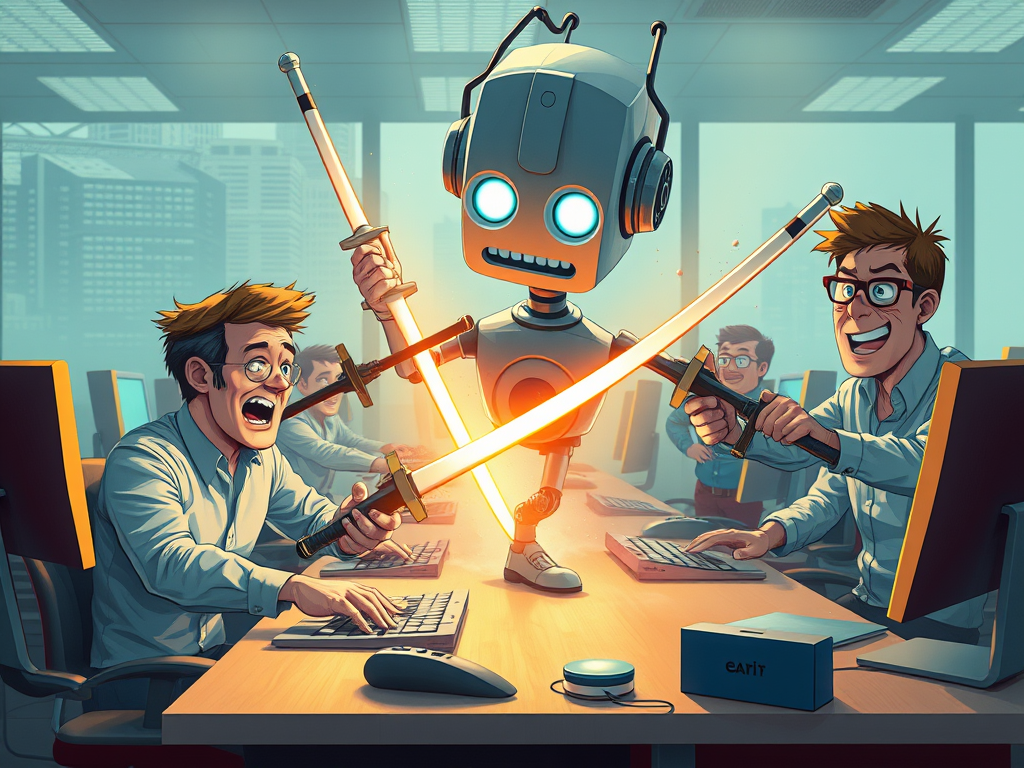
Why Replacing Software Developers with AI Is Going Horribly Wrong? and What Smart Teams Are Doing Instead?
I recently participated in a roundtable with HR leaders. We discussed topics ranging from bagels in the office to the changes in hiring over the last 2 years. The later topic has been on my mind a while now and really wanted to dig into how AI is changing Software Development. In 2023, the tech world thought AI would replace up to 80% of software developers by 2025. A terrifying prediction some might say. By 2024, all I read about was layoffs, redundancies, restructuring, downsizing. You name it, Software Engineers were losing their jobs hand over fist. By early 2025 big firms were “realigning” for an AI-centric future.
Fast forward to 2026 and the story looks very different. AI didn’t eliminate the need for developers. It won’t! What it will do is expose how expensive “cheap code” becomes when nobody can maintain it, secure it, or take responsibility for it.
The promise: fewer developers, more output
The original pitch was simple: agentic tools would write code, ship features, and reduce headcount. Some leaders even highlighted how much code was being generated by AI (for example, claims that a significant portion of new code at major firms was AI-generated).
But the reality inside most organisations is more awkward: AI is widely “integrated,” yet it hasn’t translated into measurable business outcomes or reduced staffing in a meaningful way. In many cases, it’s created new work.
The problem isn’t AI code. It’s vibe coding
A big driver of the mess is what developers have started calling “vibe coding”: prompting software into existence.
It looks impressive in a demo. You can generate screens, endpoints, and quick prototypes fast. The trouble shows up later—when the system needs to scale, integrate, or survive real-world edge cases.
Research highlighted in the video points to a pattern:
- AI-generated code tends to be simpler and more repetitive
- It’s often less structurally diverse
- It can lack the connective tissue that makes systems robust and maintainable
In other words: it can work today, but it’s fragile tomorrow.
The bill arrives as technical debt (and it’s enormous)
The video frames this as a global technical debt crisis—where organisations tried to save money on engineering now, but effectively took out a high-interest loan against the future.
One headline figure cited: analysis suggesting it would take 61 billion work days to pay down existing technical debt globally.
A key mechanism behind this is “code cloning”: instead of producing clean reusable logic, AI often reproduces similar blocks of code in multiple places. That creates a growing “slop layer”—code that runs, but nobody fully understands.
And when nobody understands it, nobody can fix it quickly when it breaks.
Security gets worse, not better
The video also highlights a major risk that tends to get buried under productivity hype: security.
A cited report claims that a large share of AI-generated code contains common vulnerability patterns (including OWASP Top 10 categories), with some languages showing particularly high failure rates.
If you’re a CTO, Head of Engineering, or even a non-technical founder, here’s the practical takeaway:
- AI can generate code faster than humans
- It can also generate insecure code faster than humans
- The speed only helps if you have strong review, testing, and ownership
“AI babysitters”: senior engineers aren’t faster
One of the most telling points is that experienced engineers can become slower when AI is introduced badly.
Why? Because the job shifts from building to supervising:
- reviewing hallucinations
- correcting subtle logic errors
- untangling changes that look syntactically correct but behave dangerously
The video cites examples like AI-generated pull requests containing significantly more issues than human-written ones—meaning the review burden increases.
So the “productivity gain” often gets paid back (with interest) through QA, debugging, incident response, and rework.
The junior hiring “death spiral”
This is the part most businesses should be worried about long-term.
The video argues that companies assumed AI could handle junior-level tasks, so entry-level hiring dropped sharply between 2023 and 2025.
That creates a pipeline problem:
- If you don’t hire juniors today, you don’t have seniors in 3–5 years
- If AI does the boilerplate, juniors lose the training ground
- Juniors are then expected to jump straight into architecture-level thinking
That’s not how engineering capability is built.
The job market shift: AI hype becomes a wage lever
While companies are realising they still need humans, many are also using the AI narrative as leverage in salary negotiations.
The logic goes like this:
“We need a human to oversee architecture, but since AI does 40% of the work, we can’t pay 2022 salaries.”
The video calls this a bluff—but a bluff that’s working in a market flooded with displaced talent.
The Builder.ai scandal and the accountability gap
The video points to the Builder.ai collapse as a cautionary tale of “AI-washing”: marketing autonomy while relying heavily on human labour behind the scenes.
It also shares a more direct operational risk: AI tools taking destructive actions without the one thing software engineering requires—accountability.
When a human makes a mistake, you can coach them, change process, and assign responsibility. When an AI makes a mistake, you still need humans to:
- diagnose what happened
- restore systems
- prevent recurrence
- explain it to customers and leadership
The bottom line for 2026
AI didn’t replace developers.
It replaced the delusion that software development is a simple, automatable task. The teams that are winning aren’t the ones trying to prompt their way to success. They’re the ones reinvesting in:
- senior architects
- strong engineering management
- disciplined reviews and testing
- clear ownership and accountability
Because “free AI code” can become the most expensive debt a business ever takes on.
Practical takeaways (for leaders and hiring managers)
If you’re building product teams in 2026, a more realistic approach looks like this:
- Use AI to augment developers, not replace them
- Keep senior engineers close to architecture and review
- Invest in maintainability: tests, observability, documentation
- Protect the junior pipeline: hire, train, and give real work—not just AI supervision
- Treat AI output like entrusted input until proven otherwise
- Use a trusted knowledgeable Recruiter, like me. To help you source good Developers.
If you want a competitive advantage, don’t ask “How do we cut developers?”
Ask: “How do we ship faster without creating a system nobody can maintain?”