




AI Can Screen Your Candidates. It Still Cannot Judge Them. As a Recruiter in Dublin, I am very focused on how AI will effect Recruitment and what we should be doing. Why human expertise in specialist recruitment is not a legacy feature, it is the whole product. Recruitment is not easy, if AI is your whole Recruitment strategy, give me a call!
There is a question running through every serious conversation about AI and hiring right now, and most people are dancing around it.
The polite version sounds like this: “How do we use AI to support recruiters?”
The honest version is harder: “If AI can do most of what recruiters do, why do we still need recruiters?”
This post is an attempt to take that question seriously rather than dismiss it. Because dismissing it would be dishonest — and the recruitment industry has enough of that already.
What AI Can Actually Do (And It Is Quite a Lot)
Let us be direct. AI systems today can write job descriptions with reasonable accuracy. They can parse thousands of CVs in seconds, surface candidates who match a defined skills profile, and flag gaps. They can summarize interview transcripts, score candidates against structured criteria, analyze communication patterns, and predict — with some statistical validity — which hires are likely to stay past the 12-month mark.
That is not a threat to take lightly. These are tasks that consume significant recruiter time and introduce significant human error. Unconscious bias in CV screening is well-documented. Fatigue affects interview judgment. Memory is unreliable. AI systems do not have these problems in the same way.
So the challenge is real. If a machine can do it faster, more consistently, and without the cognitive load — why introduce human judgment at all? Human judgment is, after all, notoriously imperfect. We are influenced by first impressions, accents, confidence, and charisma in ways that often have nothing to do with job performance.
The argument for AI in Recruitment is not a weak one. It deserves a direct answer.
The Pattern Problem. The issue at the center of it is AI systems are trained on historical data. They learn to recognize patterns in what has worked before. A model that predicts high-performing software engineers is learning from the hiring decisions, tenure records, and performance reviews of software engineers who were hired by organizations like yours, in conditions roughly like now, in a past that is already gone.
This is useful. But it contains a structural flaw.
The most valuable hires: The ones who change the trajectory of a team, a product, or a company, frequently do not look like the patterns that preceded them. A data center operations lead who built her entire career through military logistics. A cybersecurity analyst who spent three years running a small business and came back to technical work with a depth of judgment that no bootcamp produces. A network engineer who has been out of the market for eighteen months caring for a family member, whose skills are current and whose motivation is exceptional.
AI looks at these candidates and sees anomalies. Experienced (Good) recruiters look at them and see opportunity.
The irreplaceable human function in recruitment is not screening for fit with the past. It is judgment about potential in the future and those are different things.
What Data Cannot Capture: There is another dimension here that is harder to quantify.When a specialist recruiter speaks with a candidate, they are not just verifying information. They are reading a situation. Why did this person leave their last role? The CV says “seeking a new challenge.” What does that actually mean? Sometimes it means exactly that. Or it means the team collapsed, the leadership was poor, or the candidate was pushed. Does it mean the candidate left under circumstances that matter to the client. And sometimes it means the candidate is simply ready for something more and has not had anyone help them articulate it properly.
A recruiter who has spent twenty years in a specific sector develops a calibrated sense for these distinctions that is extremely difficult to encode. They know the companies in their market. They know the reputations, the management cultures, the typical notice period politics, the difference between a company that says it offers flexibility and one that actually does.
This is not mystical. It is accumulated, structured knowledge that takes years to build. (If you are working with a Recruiter with 1-2 years expeirence, you might as well use an AI machine – they do the same job). And it shows up in conversations — in the questions asked, the signals read, and the conclusions drawn — in ways that a general-purpose AI assessment tool cannot replicate.
Relationship Is Not a Feature. It Is the Foundation.
Recruitment at the specialist level is not a transaction. It is a relationship conducted over time. The relationship between a recruiter and a candidate includes years of occasional contact, honest guidance when the candidate was not right for a role, introductions made without a fee in sight, and the kind of candid advice that only comes when someone trusts that you are not simply trying to fill a position. Only experienced recruters see the value in reciprocity. Those late night whatsapp messages, interview advice for jobs that your not involved with. Leaving a lasting impression on any job seeker, fee or not is critical for building trust in your sector area. Money hungry sales focused and junior recruiters don’t do this.
The relationship between a recruiter and a client should be built on a deep understanding of that organization’s actual hiring needs, not just the job description, but the team dynamics, the manager’s communication style, the precise gap that the hire needs to fill, and the culture that will either retain or lose a good person within twelve months.
No algorithm generates that. It is built through consistent, honest interaction over time. And it is the reason that when a skilled specialist recruiter presents a candidate, the client takes it seriously — not because a system has ranked them highly, but because there is a human being accountable for the recommendation.
In Specialist Sectors, the Nuances Run Deep
This matters most in technical and engineering recruitment — which is precisely where Elwood Roberts works.
Hiring a data center operations manager is not the same as hiring any operations manager. The certifications matter, but so does the specific infrastructure environment, the shift structure, the scale of the estate, and whether the candidate has the temperament for the particular operational pressures involved. CompTIA A+ is a threshold requirement for many clients in this space. What sits above that threshold is not easily captured in a job posting.
Cybersecurity is similar. The difference between a candidate who has spent three years in a Security Operations Centre and one who has held the title but never managed a live incident is not visible on a CV screened by keyword. It surfaces in conversation, in the right questions, in the candidate’s account of what they actually did at 11pm when the alert came in.
Alarm engineering is another example. Experience in this sector is valued far more than formal qualifications. Knowing that — and knowing how to evaluate it — requires sector-specific knowledge that a general hiring platform simply does not carry.
The same is true in software, electrical engineering, and mechanical building services. The details matter enormously, and the details are not in the data.
AI Makes Good Recruiters Better. Full Stop.
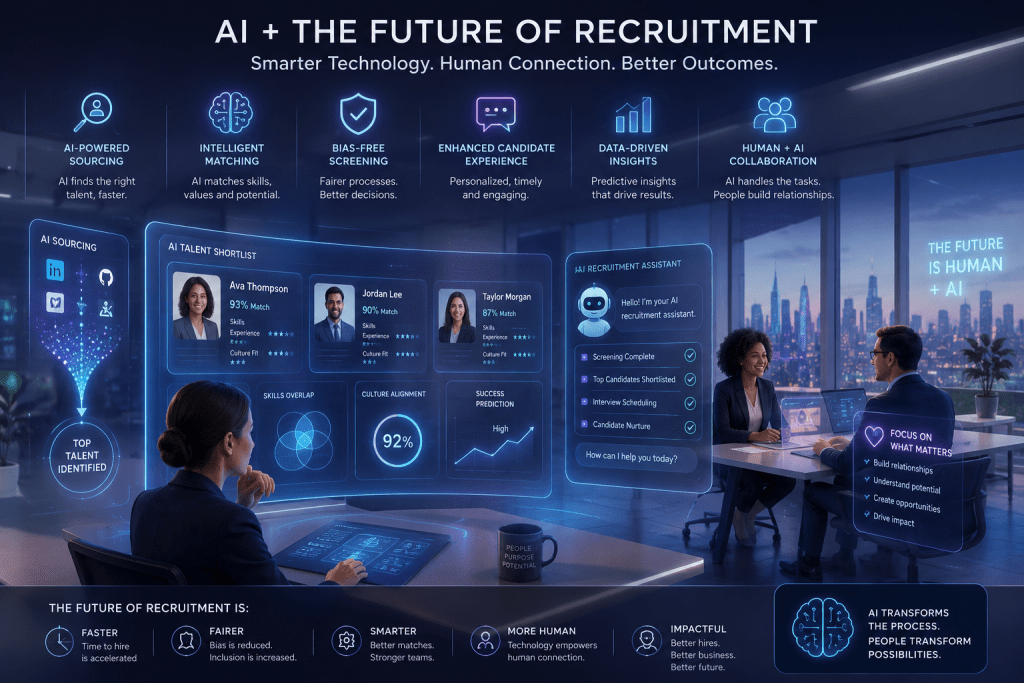
None of this is an argument against using AI in recruitment. It is an argument against using it as a replacement for expert judgment. There is a real distinction between AI-assisted recruiting and AI-led recruiting. The first is valuable. The second is a liability particularly in specialist hiring where the cost of a wrong placement is high, the candidate pool is relatively small, and the trust relationship between recruiter and client is the whole basis of the engagement.
At Elwood Roberts, AI tools are part of the workflow. Our CRM handles ATS functions such as tracking, pipeline management, engagement and search, in ways that free up time for the work that requires human attention. We have AI Interviewing applications that enables rigorous technical skills assessments for jobs like Data Center techncians, software engineering and network engineering roles, adding a structured, objective layer to the evaluation process. These tools make it possible to serve a focused client base at a higher standard, not to replace the judgment that underpins the service.
The right question is not “human or AI?” It is “which humans are using AI well, and which are hiding behind it?”
A recruiter who uses AI to do less thinking is a less valuable recruiter. A recruiter who uses AI to do better thinking, to spend less time on screening and more time on the conversations that actually move things forward — is a better one.
The deeper issue in the AI and recruitment debate is one of accountability.
This one is important: When AI makes a poor hiring recommendation, who is responsible? When a candidate is incorrectly filtered out, or incorrectly advanced, what happens? When a placement fails, who stands behind it?
Human recruiters are accountable in a way that systems are not. An experienced specialist recruiter who presents a candidate to a client is staking their professional reputation on that recommendation. They know the candidate, know the client. They are reachable, liable, and they care, because their business depends on it. Fees are paid, that fee is like an insurance policy. If the person works out, the client will most likely use that Recruitment agency in Ireland again. The Best Recruitment Agencies have repeat customers time and time again. Elwood Roberts for example have plans in place if people drop out, we replace free of charge (for a set period of time). We have pride in our work, its not all about the fee!
That accountability is not a small thing. It is the reason that the guiding principle in this practice is simple: not every job search ends positively, but every candidate interaction should. That commitment cannot be automated. It is a choice made by a person, in every conversation, every time.
A Final Thought
AI will continue to improve. The tools available to recruiters five years from now will be substantially more capable than those available today (which lets be honest, 90% are pretty poor, but they are learning/developing all the time). Some tasks that currently require human judgment will, over time, be performed reliably by systems.
But the trajectory of technology does not change what is true right now: specialist technical hiring in complex sectors requires accumulated expertise, contextual judgment, and trusted relationships that AI tools cannot replicate.
The question is not whether AI changes recruitment. It does and will. The question is whether the humans in the loop are adding something real — or just adding latency.
The answer, in specialist recruitment done properly, is that they are adding everything that matters.
If you are navigating a complex hiring challenge in IT, data centres, engineering, or cybersecurity — in Ireland, across the EU, or in the US — and you want a direct, honest conversation about your options, reach out. No pitch, no pipeline, just a discussion about what you actually need.